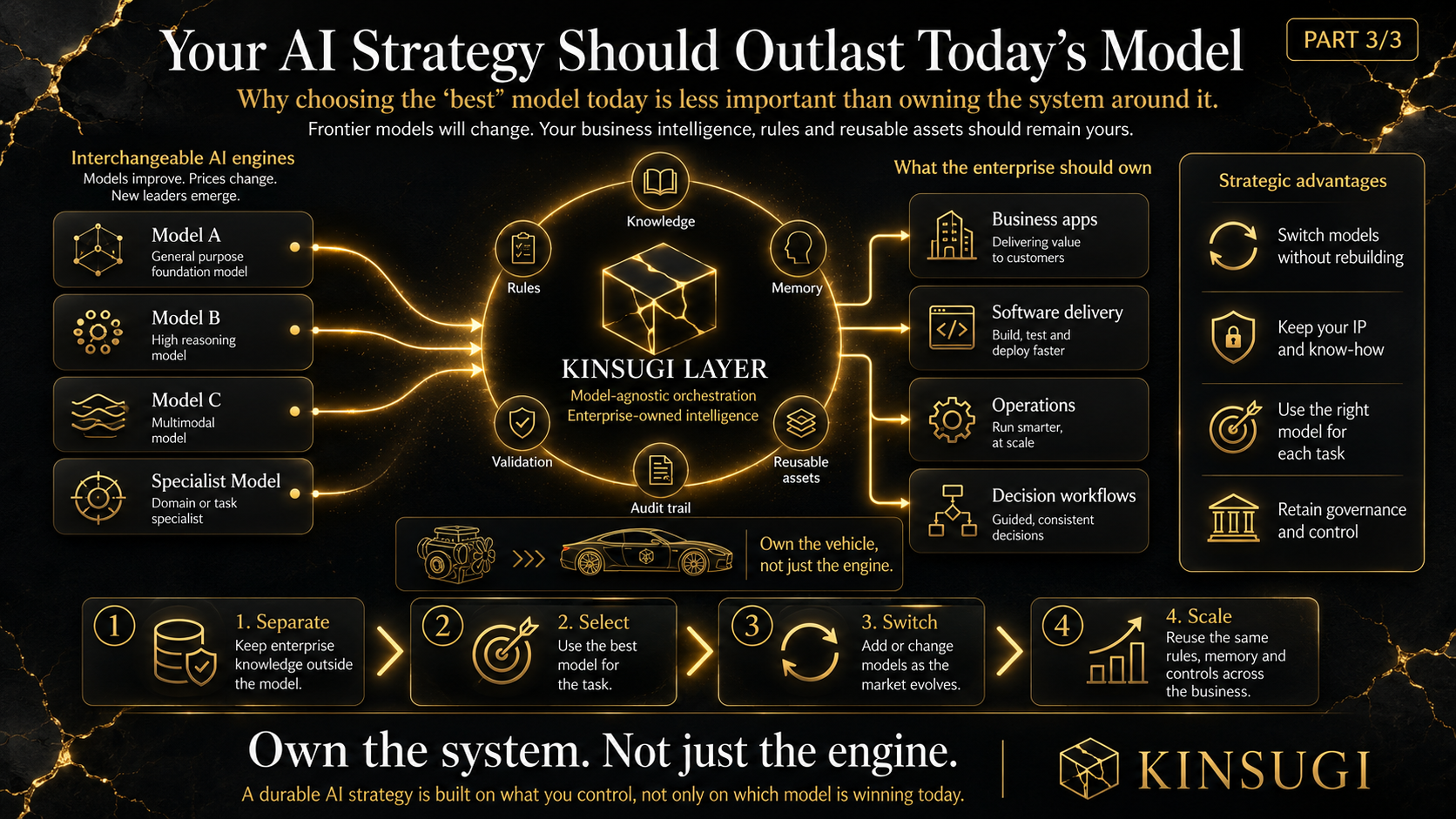
Artificial intelligence is no longer a competitive advantage—it is a business requirement. Yet most enterprise organisations struggle to move beyond pilot projects and proof-of-concepts. The challenge is not technology availability, but organisational structure. Companies need an AI Factory: a dedicated, cross-functional operation designed to develop, deploy, and scale AI solutions at enterprise pace and precision.
The AI Scaling Problem
Enterprise businesses invest heavily in AI initiatives, but fail to achieve meaningful returns at scale. Individual departments experiment with machine learning in isolation. Data scientists build models that never reach production. Investments in tools and talent yield inconsistent results across the organisation. This fragmentation wastes resources and leaves competitive gaps unaddressed.
The root cause is operational immaturity. Without a structured approach to AI development, enterprises default to ad-hoc, siloed projects. They lack the governance frameworks, standardised workflows, and cross-team coordination required to move ideas from concept to production efficiently.
What is an AI Factory?
An AI Factory is a centralised yet distributed operating model that treats AI development as a systematic, repeatable process rather than bespoke experimentation. It combines dedicated teams, standardised workflows, shared infrastructure, and clear governance to produce AI solutions at scale.
The model sits between a fully centralised AI department and completely decentralised departmental initiatives. It provides guardrails, resources, and expertise while enabling business units to drive their own AI roadmaps. Think of it as a production line for intelligence: inputs go in, validated AI solutions come out.
Core Components of an AI Factory
- Centralised Data Infrastructure: A unified platform for data ingestion, preparation, and governance. This eliminates data silos and ensures consistent data quality across all AI projects.
- Dedicated AI Teams: Data engineers, machine learning engineers, and specialists focused exclusively on building production-grade AI systems, not one-off experiments.
- Standardised Workflows: Repeatable processes for model development, validation, deployment, and monitoring. This reduces time-to-value and ensures quality consistency.
- Governance and Compliance: Clear frameworks for model accountability, bias detection, regulatory compliance, and risk management. Essential for regulated industries.
- Tools and Platform Integration: A curated stack of technologies that teams can rely on, reducing tool sprawl and enabling knowledge transfer across projects.
- Business Partnership Model: Formal linkages between the AI Factory and business units to ensure projects align with strategic priorities and deliver measurable ROI.
Why Enterprises Need This Now
Competitive pressure is accelerating. Organisations that can rapidly develop and deploy AI solutions at scale will outpace those stuck in pilot mode. An AI Factory enables this velocity by removing friction from the development cycle and creating a culture of continuous AI delivery.
Talent scarcity demands efficiency. High-quality data scientists and ML engineers are scarce and expensive. An AI Factory maximises their impact by eliminating context-switching, centralising expertise, and automating repetitive tasks. One team can support more projects with higher quality outcomes.
Risk and compliance are non-negotiable. Unmonitored AI systems create liability, especially in financial services, healthcare, and regulated sectors. A structured factory model embeds governance, auditability, and compliance into the development process from day one, not as an afterthought.
Data is an asset, not a liability. Many enterprises have rich data but no systematic way to extract value from it. An AI Factory builds the infrastructure and processes to unlock data value across the organisation, turning data into a genuine competitive moat.
Implementation Considerations
Building an AI Factory is not an overnight transformation. It requires executive sponsorship, clear investment, and organisational alignment. Start with pilot processes, establish early wins, and scale proven patterns. Most enterprises benefit from external partnership during the design and initial implementation phases to avoid common pitfalls and accelerate time-to-capability.
The investment pays dividends. Organisations with mature AI Factories report faster model deployment, lower project failure rates, better model governance, and measurable ROI from AI initiatives. In a data-driven economy, this operational model is not optional—it is essential.